
In October, I joined peers from around the world at the Public Innovators Network Summit 2025, hosted by the Bloomberg Center for Public Innovation at Johns Hopkins University in Baltimore, Maryland. The summit brought together local government innovation leaders to exchange ideas, strengthen networks, and share strategies for transforming public service. Sessions ranged from building innovation infrastructure and youth-driven policy to data collection and portfolio management. It was an energizing reminder of why I love this work.
It was inspiring to meet people I admire, reconnect, make new friends, and gather a mix of ideas, tools, and practices to help us show up to work centered and creative in the face of complex civic challenges. I came home both inspired by others and more grounded in my own practice — ten years of experimentation, learning, and persistence that have culminated in an impact-driven model for innovation I’m proud of and honored to share.
1️⃣ Data can be made visible through art
In Iceland, Arna Ýr Sævarsdóttir’s team transformed youth data into art — turning numbers into a piece that inspires empathy. Working with an artist-in-residence, they helped young people interpret their own survey responses through visual and tactile creations that ultimately hung in a gallery.

Through this effort, data became a medium for dialogue. It was a way for youth to see themselves in the patterns and for adults to see youth differently. It reminded me that data, when used in powerful and creative ways like this example, can become a bridge between plain fact and human emotion. I hope to continue exploring partnerships with Seattle creatives to help us share stories and insights in meaningful ways.
2️⃣ Youth are powerful policy shapers
From Bogotá (Angela María Reyes) to Baltimore (Terrance Smith) to Guatemala City (Griscelda Cruz), I saw proof that young people don’t just participate in civic processes — they shape them. Youth can reveal blind spots adults can’t see and are deeply invested in building the systems they will inherit. In Guatemala City, youth generated over 150 ideas that became 29 implemented projects.

In Baltimore, adults were certain that youth were not joining a public safety cadet program because they didn’t trust the police. However, through problem-solving with youth, Terrance Smith uncovered that a required driver’s license was the true root cause. In Baltimore, the cost of driver’s education—$5,000 and 60 hours with a car with insurance and an adult—was a barrier for youth. This insight led the city to partner with philanthropy to fund lessons and to use that 60 hours of seat time for both mentorship and drivers education. These changes increased the number of cadets ten-fold from 4 to 40.
In Seattle, our Youth Connector initiative is taking that same spirit of co-creation and applying it to access to the City’s $200M+ portfolio of youth programs. By engaging hundreds of local teens, the City learned that awareness and relevance of programming are the biggest barriers to participation. The project is now building a youth-designed digital platform and outreach campaign to connect young people to recreation, mental health, and job-training programs and resources that fit their real lives.
3️⃣ Self-care fuels our ability to innovate
Exhaustion and burnout do not beget innovation.
Jessica MacLeod demonstrated how taking a few minutes while waiting for the water to boil can turn into a morning practice to get energized, practice gratitude, and reset before the day begins. Liana Elliott introduced the concept of trauma-informed public service, a framework that acknowledges the emotional weight of government work. Michael Baskin reminded me how tools from Liberating Structures, like Question Storms or Troika Consulting, keep teams curious, playful, and open to new ideas.
Creativity requires care. Self-care is necessary infrastructure to bring our best thinking to work.
4️⃣ Work is love made visible
During a communications workshop, Tiger Abdur-Rahman said something that stayed with me: “Work is love in action.”
I later looked up the Kahlil Gibran quote he was referencing: “Work is love made visible.” It struck me as especially relevant to those of us who work in data, dashboards, and policy. Every chart, program, or spreadsheet ultimately represents people — their lives, their challenges, their stories.
If we design and communicate with that in mind, our work becomes less technical and more relational. We make care and love visible in how government sees and responds to its residents.
5️⃣ Institutionalizing innovation takes work
After my own panel, I had a chance to reflect with peers like Nneka Sobers, whose “Swiss cheese” metaphor for innovation portfolios really connected the dots for me. When she first started her role, she was handed what felt like a random assortment of projects. Over time, she aligned those disparate efforts into a living strategy that made sense of the projects she inherited and revealed the gaps, or “holes,” in the portfolio.
Her framing was such a good reminder: we can get so consumed by what’s right in front of us that we forget to zoom out and see the bigger picture. Nneka shared five practical tools to help teams prioritize their work, identify the missing pieces, and communicate the logic behind their portfolio to key stakeholders to build shared understanding and agreement around the approach.
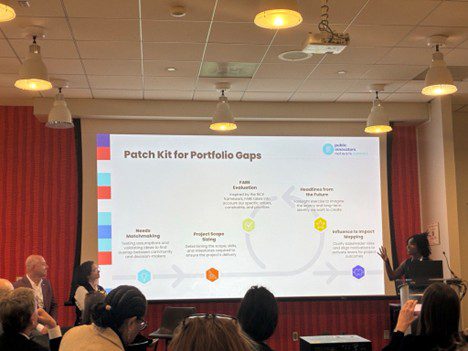
In our case, embedding innovation within the City Budget Office has allowed us to sustain this work across four mayors and align with shifting policy priorities without losing sight of long-term goals. It’s not glamorous, but it’s what makes progress stick.
Closing reflections
We can design good systems, but they only work if we stay curious, grounded, and connected to the people they serve. Whether through art, youth voice, mindful practice, or institutional design, innovation is both deeply personal and profoundly public.
As one colleague put it: the way we work is part of the work.
Thank you to the BCPI team — Francisca Rojas, Justin Entzminger, Jovan Hackley, Kali-ahset Amen, Jim Anderson, Roland Persaud, Carol Coletta, Lianna Elliott, Jacquelyn Handsome, and the many others — for creating such a rich space for reflection, community, and shared purpose.